Why Chassis Code Is the Only Reliable Way to Order Pajero Parts
The Mitsubishi Pajero has been in production across four generations and at least 30 chassis variants since 1982. A 2005 Pajero could be a V63W, V73W, V75W, or V78W — each with a different engine, different suspension geometry, and different bolt patterns. Year-and-model ordering is how distributors end up with containers of parts that don't fit, and that's a costly mistake when you're shipping FOB Guangzhou to Santiago or Nairobi.
The chassis code — stamped on the compliance plate inside the driver's door jamb and on the engine bay firewall — encodes the body style, wheelbase, engine, and drivetrain configuration in a compact alphanumeric string. Getting this right before placing a wholesale order saves return freight, workshop downtime, and the trust erosion that comes with wrong-part deliveries.
This guide covers all three active Pajero generations (Gen 2 through Gen 4) and maps each chassis code to the correct suspension, steering, and engine components — with verified OE part numbers sourced from the Mitsubishi Electronic Parts Catalogue (EPC) and cross-referenced against Amayama and Partsouq parts databases.
How to Read a Pajero Chassis Code
The Pajero chassis code follows a consistent pattern across all generations. Understanding the structure prevents the most common ordering mistakes — especially when your customer sends you a partial code or a registration document in a language you don't read.
Chassis Code Structure
| Position | Meaning | Examples |
|---|---|---|
| 1st character | Body style | V = Wagon K = Canvas top / Pickup |
| 2nd character (digit) | Series / Wheelbase | 2/6/8 = Short Wheelbase (SWB, 3-door) 4/7/9 = Long Wheelbase (LWB, 5-door) |
| 3rd character (digit) | Engine code | 3 = 6G72 (3.0L V6) 5 = 6G74 (3.5L V6) 6 = 4M40 (2.8L TD) 7 = 6G75 (3.8L V6) 8 = 4M41 (3.2L Di-D) |
| 4th character | Configuration | W = 4WD Wagon |
Where to Find the Code
- Compliance plate — inside the driver's door jamb (most reliable location)
- Firewall — engine bay, passenger side (may be corroded on older vehicles)
- Registration documents — listed as "Type" or "Model" in most markets
Workshop tip: When customers bring in vehicles without documentation, photograph the door jamb plate and cross-reference with the engine code on the cam cover. If they don't match, the vehicle has had an engine swap — order parts to the chassis, not the engine.
Pajero Chassis Code Reference Tables
Every Pajero generation uses a distinct chassis code series. The tables below cover all major production variants still actively serviced in aftermarket — from the V20/V40 series (Gen 2) through the V80/V90 series (Gen 4). Each row is cross-referenced against the Mitsubishi Electronic Parts Catalogue and verified against Amayama and Partsouq listings.
Generation 2 — V20/V40 Series (1991–1999)
The second-generation Pajero introduced the Super Select 4WD system and the 4M40 turbodiesel that would become the workhorse engine across Africa and the Middle East. Gen 2 vehicles still represent a significant aftermarket volume in markets like Kenya, Tanzania, and Pakistan where these trucks run well past 300,000 km.
| Chassis Code | Wheelbase | Engine | Displacement | Key Markets |
|---|---|---|---|---|
| V23W | SWB (3-door) | 6G72 V6 | 3.0L Petrol | Japan, Asia |
| V24W | SWB (3-door) | 4D56T | 2.5L Turbo Diesel | Global |
| V26W | SWB (3-door) | 4M40 | 2.8L Turbo Diesel | Australia, Middle East |
| V43W | LWB (5-door) | 6G72 V6 | 3.0L Petrol | Japan, Middle East |
| V44W | LWB (5-door) | 4D56T | 2.5L Turbo Diesel | Global |
| V45W | LWB (5-door) | 6G74 V6 | 3.5L Petrol | Japan, US (Montero) |
| V46W | LWB (5-door) | 4M40 | 2.8L Turbo Diesel | Australia, Africa, Middle East |
Generation 3 — V60/V70 Series (1999–2006)
Gen 3 marked a fundamental platform change: body-on-frame to monocoque construction, solid axle to fully independent suspension front and rear, and recirculating-ball steering to rack-and-pinion. This generation is where most fitment confusion begins, because the chassis looks similar to Gen 2 but virtually nothing underneath interchanges (Source: Mitsubishi Gen 3 platform technical documentation).
| Chassis Code | Wheelbase | Engine | Displacement | Key Markets |
|---|---|---|---|---|
| V63W | SWB (3-door) | 6G72 V6 | 3.0L Petrol | Japan, Middle East |
| V65W | SWB (3-door) | 6G74 V6 | 3.5L Petrol (GDI) | Japan |
| V68W | SWB (3-door) | 4M41 Di-D | 3.2L Turbo Diesel | Australia, EU |
| V73W | LWB (5-door) | 6G72 V6 | 3.0L Petrol | Global |
| V75W | LWB (5-door) | 6G74 V6 | 3.5L Petrol (GDI) | Japan, US (Montero) |
| V78W | LWB (5-door) | 4M41 Di-D | 3.2L Turbo Diesel | Australia, EU, Middle East |
Generation 4 — V80/V90 Series (2006–2021)
Gen 4 refined the Gen 3 platform with updated interior, revised electronics, and MIVEC variable valve timing on the petrol V6 engines. The underlying suspension architecture carried over from Gen 3, and many suspension parts interchange directly — particularly lower control arms and shock absorbers (Source: cross-reference data from Amayama parts catalog).
| Chassis Code | Wheelbase | Engine | Displacement | Key Markets |
|---|---|---|---|---|
| V83W | SWB (3-door) | 6G72 V6 | 3.0L Petrol | Japan |
| V87W | SWB (3-door) | 6G75 MIVEC V6 | 3.8L Petrol | Japan |
| V88W | SWB (3-door) | 4M41 Di-D | 3.2L Turbo Diesel | Global |
| V93W | LWB (5-door) | 6G72 V6 | 3.0L Petrol | Middle East, Russia, Global |
| V97W | LWB (5-door) | 6G75 MIVEC V6 | 3.8L Petrol | Japan, Australia |
| V98W | LWB (5-door) | 4M41 Di-D | 3.2L Turbo Diesel | Australia, EU, Middle East, Global |
Download the one-page quick-reference card. Print it, tape it to your ordering desk — every chassis code, engine, and wheelbase on a single A4 sheet: download PDF →
Generation 2 Suspension & Steering: What to Know (V20/V40)
Gen 2 Pajeros use independent front suspension with torsion bars — not a solid axle. This is a common misconception, partly because earlier Gen 1 models did use a solid front axle setup. The Gen 2 torsion bar IFS with upper and lower control arms was a significant upgrade that improved on-road handling while maintaining off-road capability. If you're also sourcing for Toyota Hilux or Mitsubishi L200/Triton, note that these use different suspension architectures despite similar market positioning (Source: Mitsubishi technical documentation, Gen 2 service manual).
Front Suspension — V20/V40 Series
| Component | OE Reference | Notes |
|---|---|---|
| Front lower control arm (LH / RH) | MR162803 / MR162804 | Shared across V24W, V44W, V46W |
| Front upper control arm (LH / RH) | MR296095 / MR296096 | Shared across V24W, V44W, V46W; alt. MR162691/692 |
| Lower ball joint | MB176308 | Press-in type; do NOT substitute Gen 3 parts |
| Front shock absorber | MR112341 | Standard hydraulic; alt. MB831034 |
| Front torsion bar (LH / RH) | MB932019 / MB932020 | Gen 2 exclusive — Gen 3 switched to coil springs |
| Steering tie rod end (outer / inner) | MB831043 / MB831044 | Recirculating ball steering system; LHD and RHD differ |
Importer note: Gen 2 uses a recirculating ball steering system with separate pitman arm (MB831040) and idler arm (MB831042). The front stabilizer link is MB831039. Gen 3 switched entirely to rack-and-pinion. None of these steering components cross over between generations.
Rear Suspension — V20/V40 Series
Gen 2 uses a live rear axle — coil springs on LWB models (V43/V44/V45/V46), leaf springs on some SWB variants. The U-bolts are M12×1.25, 65mm width. Confirm this specification before ordering spring kits, as aftermarket kits sometimes ship with M14 hardware intended for larger trucks.
Generation 3 Suspension & Steering: The Platform Shift (V60/V70)
Gen 3 redesigned everything underneath the Pajero. The switch from body-on-frame to monocoque construction brought fully independent suspension front and rear — double-wishbone with coil springs at all four corners. This is the critical distinction for parts sourcing: nothing from Gen 2 fits Gen 3, and assuming interchangeability is the most expensive mistake in Pajero parts importing (Source: Mitsubishi Gen 3 platform documentation).
Front Suspension — V60/V70 Series
| Component | OE Reference | Notes |
|---|---|---|
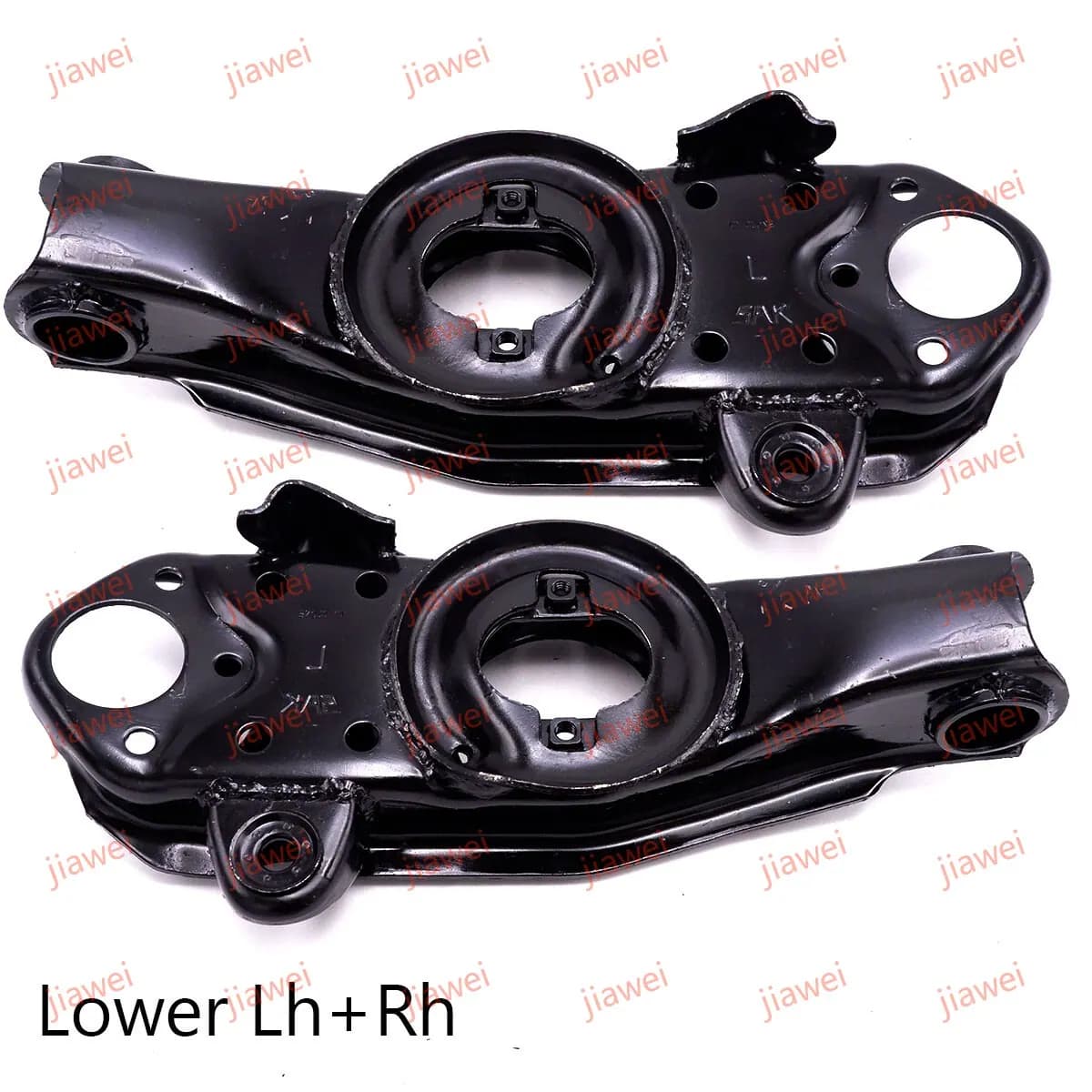
| Front lower control arm (LH / RH) | MR374835 / MR374836 | Steel; superseded by 4013A209 / 4013A210 in Gen 4 |
| Front upper control arm (LH / RH) | MR403441 / MR403442 | Shared with Gen 4; aluminium construction |
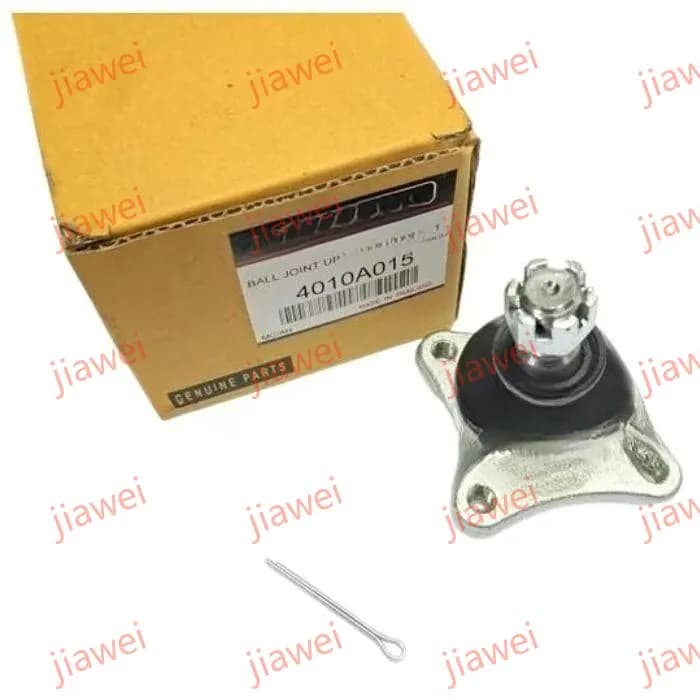
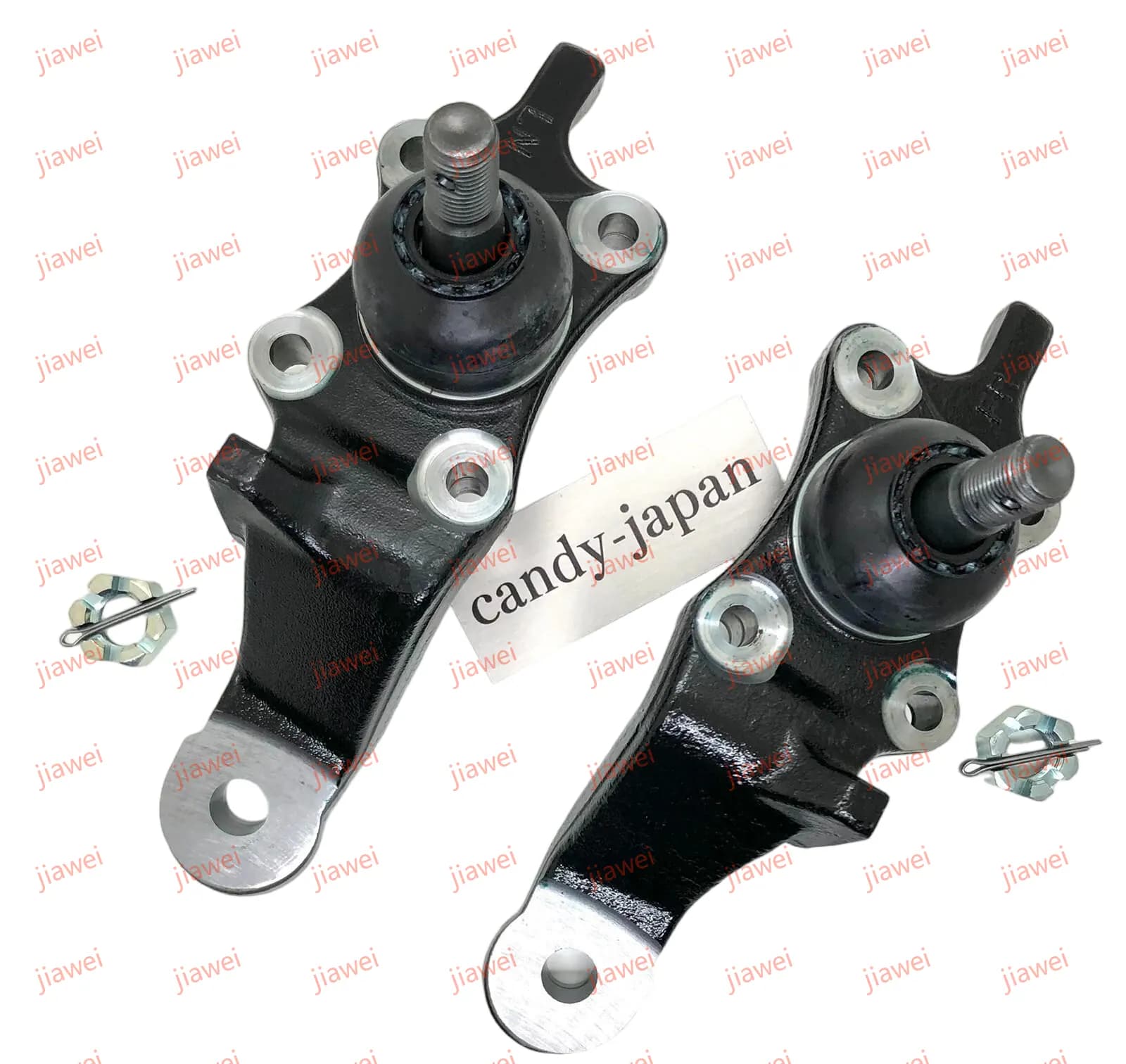
| Lower ball joint | MR374826 | Separate replaceable unit, unlike Gen 2 press-in |
| Front shock absorber | MR510449 | Coil-over type; alternative OE ref MR403437 |
| Steering rack assembly | MR374187 | Hydraulic power rack-and-pinion; LHD/RHD specific |
| Rear shock absorber | MR403061 | Independent rear suspension (IRS) — NOT live axle |
Powertrain Notes — 4M41 Di-D (V68W / V78W)
The 3.2L 4M41 Di-D turbodiesel — introduced with Gen 3 — uses a timing chain, not a timing belt. This is a significant maintenance advantage over the 6G72 V6 petrol (which uses a timing belt with a recommended 100,000 km service interval). The 4M41 timing chain is good for the life of the engine under normal service conditions (Source: Mitsubishi 4M41 engine specifications).
High-demand 4M41 wholesale parts include the high-pressure fuel injection pump (OE: 1460A022), which is the most commonly replaced fuel system component on high-mileage units serving mining and agricultural fleets.
Generation 4 Parts Fitment: What Changed from Gen 3 (V80/V90)
Gen 4 shares the Gen 3 monocoque platform with refinements rather than a redesign. For parts importers, this is good news: many suspension components interchange directly between late Gen 3 and Gen 4 vehicles. The upper control arm (MR403441/MR403442) is identical across both generations. The lower control arm was revised — Gen 4 uses 4013A209/4013A210 as the current revision — but the mounting points are compatible with Gen 3 subframes (Source: Amayama cross-reference data).
Front Suspension — V80/V90 Series
| Component | OE Reference | Notes |
|---|---|---|
| Front lower control arm (LH / RH) | 4013A209 / 4013A210 | Latest revision; direct replacement for Gen 3 MR374835/836 |
| Front upper control arm (LH / RH) | MR403441 / MR403442 | Same part as Gen 3 — shared inventory opportunity |
| Lower ball joint | 4013A332 | Heavy-duty revision for V80/V90 series |
| Front shock absorber | 4062A022 | Specific to 3.2L Di-D (heavier engine weight) |
| Steering rack assembly | 4410A053 | Hydraulic; some V97W Japan spec have EPS |
| Front stabilizer link (LH / RH) | MR392723 / MR392724 | Sway bar end links; high-turnover service item |
Stocking strategy for distributors: Stock Gen 3 and Gen 4 suspension parts together. The upper control arm (MR403441/MR403442) covers both generations. Use the lower control arm as your split point — MR374835/836 for Gen 3, 4013A209/210 for Gen 4. This simplifies warehouse management and reduces dead stock.
Critical Mitsubishi Pajero Parts That Differ Between Generations
This is the reference table to keep at your ordering desk. These components are the most commonly confused across Pajero generations — and the most expensive when ordered wrong. Every item below has been verified against the Mitsubishi EPC catalog and cross-referenced with Amayama parts listings.
| Component | Gen 2 (V20/V40) | Gen 3 (V60/V70) | Gen 4 (V80/V90) |
|---|---|---|---|
| Construction | Body-on-frame | Monocoque | Monocoque |
| Front suspension | IFS, torsion bars | IFS, double-wishbone, coil | IFS, double-wishbone, coil |
| Rear suspension | Live axle (coil or leaf) | Independent (IRS), multi-link | Independent (IRS), multi-link |
| Steering type | Recirculating ball | Rack and pinion | Rack and pinion (EPS on some) |
| Lower control arm | MB831038/037 | MR374835/836 | 4013A209/210 |
| Upper control arm | MB831042/041 | MR403441/442 (shared Gen 3 & 4) | |
| Timing system (diesel) | Belt (4M40) | Chain (4M41) | |
| Primary diesel engine | 4M40 2.8L / 4D56 2.5L | 4M41 3.2L Di-D | 4M41 3.2L Di-D |
OEM vs Aftermarket: Quality Tiers for Mitsubishi Pajero Parts
Not all replacement parts are equal, and understanding quality tiers prevents both overpaying and catastrophic field failures. Here's how the three tiers compare for Pajero suspension and drivetrain components:
| Tier | Description | Typical Use Case | Trade-off |
|---|---|---|---|
| Genuine OEM | Mitsubishi-branded, original factory spec. Sold through authorized dealers. | Warranty-sensitive fleet vehicles; dealership workshops requiring brand compliance. | Highest cost (2–4x aftermarket); long lead times in some markets; often not stocked locally outside Japan/Australia. |
| OE-equivalent | Manufactured to OEM dimensional and material specifications. Same tolerance ranges, same grade steel/aluminium. Third-party brand with full fitment verification. | Professional workshops and distributors serving daily-driver and commercial fleets. This is the tier JIAWEI supplies. | Best value-to-quality ratio. Requires supplier verification — not all "OE-quality" claims are equal. Ask for dimensional inspection reports. |
| Budget aftermarket | Lower-grade materials, wider tolerances. May fit but with reduced durability. | Price-sensitive markets; vehicles with limited remaining service life; emergency repairs. | Shortest service life. Ball joints and tie rod ends in this tier may fail at 30–50% of OEM service intervals. Not recommended for vehicles operating in mining, agriculture, or heavy-load commercial use. |
Wholesale Sourcing Guide for Importers
We supply Mitsubishi Pajero suspension, steering, and drivetrain parts to importers and distributors across Australia, New Zealand, South Africa, the UAE, Saudi Arabia, Kenya, Colombia, and Chile. We also stock a full range of Mitsubishi aftermarket parts including Pajero Sport and L200/Triton. Our sourcing process is built around chassis code verification — not year-and-model guessing.
How Our B2B Process Works
- Send your chassis code list — full codes (e.g., V98W), not just "Pajero 2010." We cross-reference against our fitment database before quoting.
- Confirm spec — we verify LHD/RHD, engine variant, and production date range before generating your quote.
- Quote within 24 hours — FOB Guangzhou pricing; standard MOQ of 10 units per SKU for suspension components.
- Quality verification — OE-equivalent dimensional specifications; inspection reports available on request.
- Packaging — neutral white box standard; custom branded packaging available at higher volumes.
What We Stock (Pajero-Specific)
- Full front and rear suspension kits (Gen 2, Gen 3, Gen 4)
- Steering components — tie rod ends, rack ends, steering racks
- Engine timing and sealing kits — 4M40, 4M41, 6G72
- Brake components — pads, rotors, caliper rebuild kits
- Drivetrain — CV joints, propshaft center bearings, diff seals
Trial orders for first-time customers (3–5 units per SKU) are available at a small premium. Contact us to discuss your specific requirements.
Frequently Asked Questions
Can I use Gen 2 (V20/V40) suspension parts on a Gen 3 (V60/V70) Pajero?
No. Gen 2 uses body-on-frame construction with torsion bar front suspension and a live rear axle. Gen 3 uses monocoque construction with fully independent double-wishbone suspension at all four corners. The mounting points, geometry, and part dimensions are completely different. These parts are not interchangeable under any circumstances.
Which Gen 3 and Gen 4 parts are interchangeable?
The front upper control arm (MR403441/MR403442) is the same part across both generations. Stabilizer links and some shock absorber mounts also cross over. However, lower control arms, ball joints, and steering racks differ between Gen 3 and Gen 4. Always confirm by OE part number rather than assuming cross-compatibility.
What's the difference between Pajero, Montero, and Shogun?
These are regional names for the same vehicle. Pajero is used in Japan, Asia, and most export markets. Montero is used in North America and Spain. Shogun is used in the UK. All three use identical chassis codes and parts — the name difference is purely marketing.
Do you supply parts for the Pajero Sport / Montero Sport?
The Pajero Sport (chassis codes KG4W, KG6W, KH4W, KH6W, KH8W, KH9W, and newer KR/KS series) is a separate model from the full-size Pajero and uses different suspension geometry. We supply both — request a separate fitment list for Pajero Sport / Montero Sport.
What is your minimum order quantity for wholesale?
Standard MOQ is 10 units per SKU for most suspension components. First-time trial orders of 3–5 units are available at a small premium to let you verify quality and fitment before committing to full volume. Contact us with your SKU list.
How do I verify my Pajero's chassis code if the door jamb plate is missing?
Check the engine bay firewall on the passenger side for a secondary stamping. Alternatively, the full VIN (17-character Vehicle Identification Number) contains the chassis code — positions 4–6 typically encode the model series. Your local Mitsubishi dealer can decode a VIN to confirm the chassis code. As a last resort, cross-reference the engine code stamped on the cam cover against the chassis code tables in this guide.
Ready to Source Pajero Parts by Chassis Code?
Send us your chassis code list via our inquiry form or WhatsApp (+86 133-1731-2928). We'll verify fitment, confirm availability, and return wholesale pricing within one business day. Every order is chassis-code-verified before dispatch — no guessing, no wrong-part shipments.
Sources & Methodology
- OE part numbers: Sourced from the Mitsubishi Electronic Parts Catalogue (EPC) and cross-referenced against Amayama, Partsouq, and MegaZip online parts catalogs.
- Chassis code structure: Based on Mitsubishi Motors internal model designation system, verified against JDM (Japan Domestic Market) registration records and Australian ADR compliance data.
- Technical specifications: Suspension architecture, engine specifications, and timing system data sourced from Mitsubishi factory service manuals (Gen 2 SM-9202, Gen 3 SM-9302). Suspension terminology follows SAE J670 (Vehicle Dynamics Terminology).
- Market intelligence: Regional demand patterns and common fitment errors based on JIAWEI 4x4 shipping records and distributor feedback, 2019–2025.
This article was last reviewed on April 2, 2026. OE part numbers are subject to supersession — always confirm current part numbers with your supplier before placing bulk orders. If you notice any inaccuracy, please let us know.